Saturday, November 3, 2018

Belchertown's School For The Feeble Minded


Retardation, or "feeble-mindedness" was caused primarily by defective heredity and inbreeding ... Society therefore, had to be protected from such people. The Belchertown State School for the Feeble Minded was the result. Solidly built "14 miles from anywhere" in isolation, the men and women were segregated to prevent any sexual contact. 

- The Tragedy of Belchertown, Springfield Republican, in describing the philosophy that Belchertown's School for the Feeble Minded was founded under in 1922.

"The Tragedy of Belchertown" - Springfield Republican, 3/15/1970


Looking back over the last 100 years of Massachusetts' history, it's hard to find a more disturbing story than of those who resided in Belchertown's School For The Feeble Minded. The name alone will tell you this is the product of a different generation, and though established as a way to care for people unable to survive independently, for many of the residents who lived and died at this facility theirs is a story of neglect, dehumanization, and treatment in a way that many constituted downright torture.


As were many of the state hospitals from this era, Belchertown was not just a single building but dozens, constructed as a campus style facility where both patients and staff resided. It operated until 1992 when a series of lawsuits, in addition to society's change in how it viewed disabled people, finally led to its closure. Some of these buildings have since been demolished, but many remain, serving as both a reminder of our past and a modern day ghost town for urban explorers.


"State Breaks The Law Every Day" - Springfield Republican, 3/16/1970


In the Springfield Republican's six-part series "The Tragedy of Belchertown", many of the horrific conditions in which patients were kept were brought to light. It was said that some legislatures who toured the buildings became physically sick from the stench and could not continue, a stench due in part by patients being forced to sit in their own filth. Not only did many of the buildings average just one shower per 50 residents, some were punished for infractions by being locked into small rooms without a toilet.


"The Tragedy Of Belchertown" - Springfield Republican, 3/15/1970


This was a complex built for 1,000 patients, but by 1967 there were over 1,600 patients housed at Belchertown. The Springfield Republican described conditions in which during the night only two attendants oversaw every 100 residents, and sometimes it was only 1. Worse yet, the buildings contained no sprinkler systems, beds were crammed together side by side, and fire escapes remained locked.


"State Breaks The Law Every Day" - Springfield Republican, 3/16/70


As outrage built over how officials could let conditions get so bad, the former Director of Federal Programs at Belchertown explained it by saying that superintendents were "rewarded" for not spending all their budgeted funds.


Prior to several of the buildings being torn down last year, I spent an afternoon wandering among them, wondering at their history while at the same time seeing what 30 years of uncontrolled nature can do to modern structures.


Although many of the buildings were boarded up tight, you're not going to have this big of a playground without teenagers prying a few of them open, and those were the holes I looked for.


Of the handful I entered, it's hard to imagine if they'll even remain standing long enough for the city to come tear them down. What you're looking at below is not some sort of outdoor patio, but the third story of a building whose roof has collapsed and vegetation has taken over. I did not enter the room, this picture was taken from the relative safety of a cement stairway.


Rather than taking a thirty foot plunge, I exited this deathtrap and explored some of the smaller buildings where management lived. Not only were these much safer, but the remains of appliances and furniture added to their creepiness.


A 2015 fire destroyed one of these staff building, and considering there hadn't been working utilities out here for over 20 years, yeah it was considered suspicious.


Plans have been approved to develop these 900 acres into housing units, and with that vision in mind more of the buildings were taken down last year. It may not be long before this land is stripped of every last reminder of the institute and put into use once again. Not only will this remove one giant headache the town has to watch over, it will put the black eye society gave itself by its treatment of these people farther into our past.


Saturday, October 20, 2018

Interesting Graves of New England


The Witch's Grave
In a Maine graveyard that dates back to the 1600's, one grave stands apart from the rest. Mary Nasson's final resting place includes not only the usual headstone, but a stone slab that covers the entire length of her grave. In an example of the different types of problems people once dealt with, her husband placed it there to keep roaming cattle from disturbing the plot. Mundane explanations like that don't make for very good legends, though, and at some point it became said that the stone was put there to prevent Mary's evil spirit from rising from the grave. Everyone loves a good ghost story, and so over the years this has come to be known as the Witch's Grave.
Located in the Old Burying Yard in York, Maine


Died From Swallowing A Pea
If I were to consider the last time my son ate a vegetable, we'd be talking not in terms of days or weeks, but of years. I'll admit I'm not a fan of certain vegetables myself - why anyone would ever pick up a brussel sprout and stick it in their own mouth is beyond me - but he won't even go near the normal stuff like green beans or corn. We've told him he's not going to die from eating vegetables, but that argument will be harder to make if he ever sees the grave of Mary McHard, a poor woman who in 1780 died at her own table by "swallowing a pea".
Located in the Old Hill Cemetery in Newburyport, Massachusetts


Grave With A Grudge
After being excommunicated from their church for trying to build their own, separate church, Caroline and Dr Calvin Cutter's lives were reduced to a poverty that led to Caroline's death in 1838. At least, that is Dr Cutter's side of things. In a lengthy accusation where he called out several church members by name, he laid out his story for the whole world to see on his wife's grave, which is now referred to as the Grave With A Grudge.
Located in the Elm Street Cemetery in Milford, New Hampshire


Grave of a Mayflower Pilgrim
If you've ever wandered Salem Massachusetts and taken a break from witch trials lore, you might have come across this next stone. Captain Richard More, who died in 1692 at the age of 84, was a passenger on the Mayflower along with a brother and two sisters. The four siblings ranged in ages from 4 and 8 years old when they made this famous voyage, and they did it without their parents. Why anyone would send such young children to the new world remained a mystery until 1959, when a descendant of the family found 300 year old documents indicating that the children's father, Samuel More, was convinced his kids were the result of his wife's long-term affair, and he solved the problem by shipping them off as indentured servants. Sadly, three of the children died soon after arriving in America.
Located in The Burying Point Cemetery in Salem, Massachusetts


Killed With An Axe
I've often considered myself the black sheep of our family, but after seeing the grave of Gilman Spaulding I'm thinking I've been too hard on myself.  In 1842 Spaulding was "kill'd with an axe by an insane brother". Next time my siblings are in town I'm taking them to Spaulding's grave as a reminder of just how lucky they were to have me as a brother.

Saturday, October 6, 2018

Royal Arch Cave - Springfield, NH


I have a backlog of nearly 50 places we've been to that someday I hope to write about, and we are constantly adding to that list. Newer adventures get added to the bottom while I chip away at the older ones, but every now and then a place comes along that is so good it jumps right to the top. This is the case with the Royal Arch Cave in Springfield, NH.


I'd first learned of this cave in an issue of the NE Caver magazine, but because it was listed as an "overhang" cave I didn't have it high on my priority list. An overhang cave to me sounded like I'd be standing under a doorway awning, and I like my caves to be deep and dark and with the potential of being eaten by wild animals. So there is sat at the bottom of my to-do list, until recently I received an email from a reader asking if I'd ever been to it. He convinced me it was something I'd enjoy, so on a recent afternoon a group of us went to find out for ourselves.

We began our hike from a dirt lot along the side of route 114 where a trail known as the SRKG crosses, but we'd barely gotten the blood going in our legs before I was bringing the group to a halt to check out the top of this car we found. Besides being a crumpled mess, I still don't know if the bottom half was buried or just missing.


Not long after this our hike came to a stop again, but this time so we could scratch our heads at a sign telling us that the trail was closed.


Turns out they are logging this section of woods - a legitimate enough reason to close a trail - but because this was a Sunday we made it through the empty worksite without any trouble.


Our next stop was at a ledge called the North Overall, a little more than halfway into our hike.


Not knowing the cave's actual location, we reached Royal Arch Hill with the expectation we'd be doing some searching. Fortunately, the good folks who maintain the SRKG had this sign waiting for us.


But here's the trick - these directions bring you to the ledge the cave exist in, but not the cave's front door. Locate a faint path to the right of the ledge and scamper down, then soon you'll be greeted with this sight.


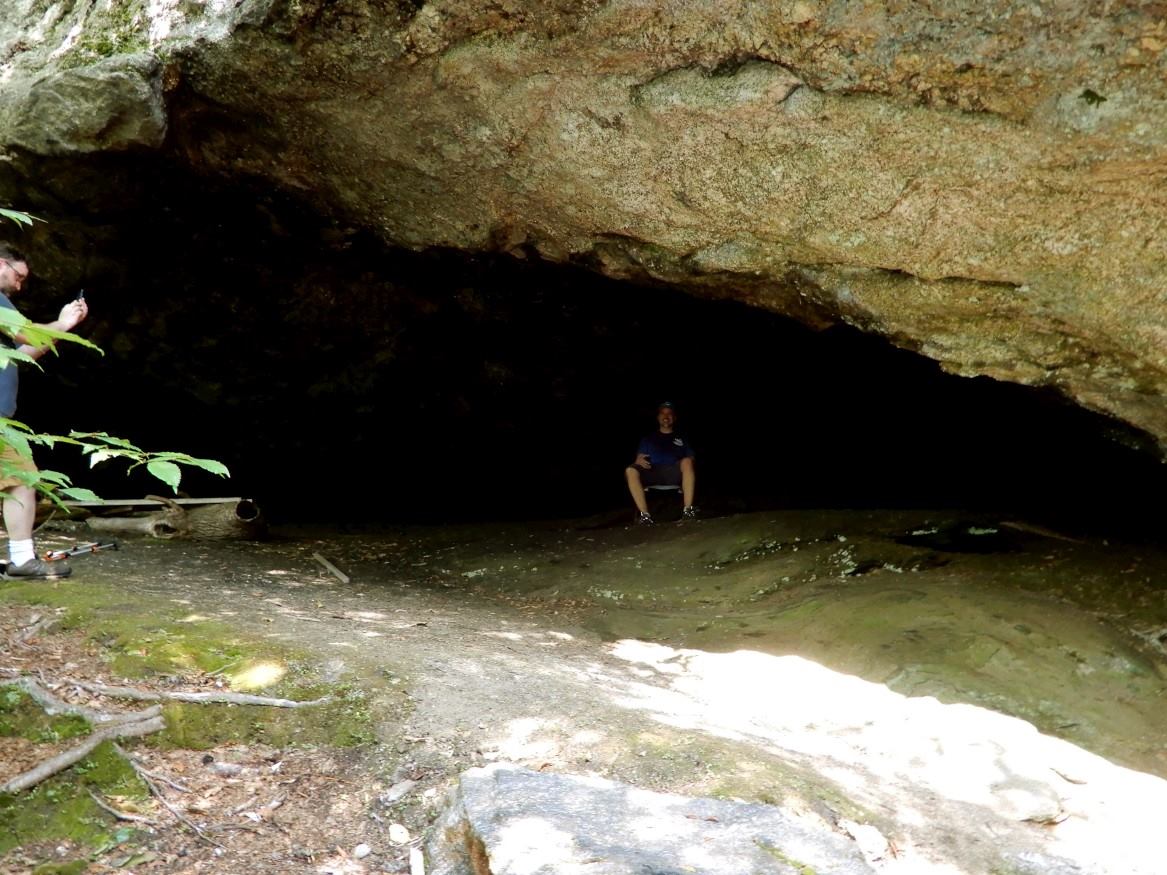
Not only was finding the cave a relief, but so was its cool air on this unseasonably warm day.


This is a large, impressive cave, which I'm convinced would be a tourist attraction if it weren't hidden three miles deep in the woods. Some people are making regular visits to it, though. A fire pit, a makeshift bench, and one of those plastic chairs you'd find in a classroom were all scattered within.


We'd been told to look in the rear of the cave for the words Royal Arch, and we easily found them carved into the wall. They were big red letters that seemed obvious to me someone took their time creating. Curious of who that was, that week I exchanged emails with the Springfield Historical Society to learn more about it, but although they are well aware of the cave and of the carving, there are no historical records of either who wrote it or how long it's been there.


My wife and I do a fair amount of hiking, but we consider ourselves explorers much more than we do hikers. This day was perfectly fitting of that description. As part of a larger trail system, this was an enjoyable area for anyone just looking to hike, but if you also have that itch to break off trail and do some exploring, the Royal Arch Cave is one of the best secret places New Hampshire has to offer.

Thank you Arnold for the suggestion!


Saturday, September 22, 2018

Ruggles Mine


It is no exaggeration to say that Ruggles Mine of Grafton New Hampshire was once a world class operation. It began in 1805 when entrepreneur Sam Ruggles began scooping up various lots of property that he'd discovered were rich with mica, and by 1810 he was extracting mica from the site at full force.


Fearing competition, Ruggles kept its location secret by employing only family to work in the mine, and by selling the mica out of a warehouse in Boston. In 1834 the mine was passed down to his son George, then over the years changed hands several times before in 1932 it was purchased by the Bon Ami Company. They mined feldspar from the pit, a multi-use mineral that at the time was used for enamel surfaces, glass cleaner, and false teeth.


Bon Ami owned it through 1959, but there ended the glory years for Ruggles Mine. American miners could no longer compete with cheap labor overseas, and most companies had turned to importing their minerals from countries like Brazil and India. Four years later Ruggles was turned into a tourist attraction, where for a small fee the public could chip away at the walls of the mine and bring home any of the cool rocks they found.


Our first trip to Ruggles was in the early 1990's. At the time I wouldn't have known a chunk of mica from a chunk of gravel, but I'd seen pictures of the place in brochures, and I dragged my wife there simply so I could wander through all its giant caverns.


That was a great trip, but although we were free to explore the open pit and chambers, the tunnels and upper levels were strictly off limits.


It wouldn't be until 25 years later that I would finally have the chance to see all the secret places Ruggles kept hidden from the public.


There were enough twists and turns in this labyrinth to actually get myself turned around a couple of times. At one point I found myself thinking I'd reached the exit, but instead was looking out a hole halfway up the cavern wall.


I spent some time fussing with my camera's timer trying to recreate a picture from 25 years ago, but it didn't work out. The sun was in no mood to cooperate and I couldn't get rid of the glare. Plus, I realized that night that I had been sitting in the wrong spot the entire time. Also, I no longer have any hair.


In 2016 Geraldine Searles, whose husband purchased the property many decades ago for $20,000, closed Ruggles Mine and put it up for sale at a $2 million pricetag. Although there has been interest, it hasn't sold yet and there's no guarantee it will open back up to the public if it does. But there is hope. A petition has been circulating online to turn this area into a state park, and New Hampshire is in the early stages of seriously considering doing this. My fingers are crossed, for until that time this historical place, and one of our states's most magnificent areas, will remain hidden from the public's view.


Links:
https://web.archive.org/web/20170420055210/http://www.rugglesmine.com:80/
http://www.nhpr.org/post/nh-exploring-idea-making-ruggles-mine-state-park#stream/0

Saturday, September 8, 2018

Remnants Of The Elbow Pond Community


If you were to visit Elbow Pond in Woodstock NH prior to the 1970's, you'd have found dozens of cottages surrounding this small body of water. Visit this same area today and you won't find a single one of those cottages remaining, but you will find plenty of evidence that there once was a small community who lived here.


There are pictures online - much better than any that I'm about to show you - which document these scattered remains, and I'd gone up the previous summer in search of them. I biked from a parking area on Elbow Pond Road until reaching the water, and although I enjoyed a couple of hours roaming through the woods, as for finding any remnants? I returned home that afternoon with my tail between my legs.

So I did what I do best when one of these searches gets me stumped, I asked for help. Joined by our hiking partner John, who by his own account had been to Elbow Pond oh around six or seven times, a group of us broke out the snowshoes in the winter of 2018. Going in the snow was not an error in judgement, it turns out that many of the remnants are on the far side of the pond, and rather than trying to reach them through marsh and swamp during warmer weather, we'd instead be enjoying a leisurely stroll across the ice.


If there was one single thing I wanted to find on this trip, it was this truck. Half buried in the ground and with some crazy homemade winch mounted to the front, its picture is what had originally put Elbow Pond on my map of places to explore.


We also found the second vehicle on my hit list, this smiling relic.


Although located in somewhat of a remote location, we did come across a few other people that afternoon: some ice fishermen, a few cross country skiers, and by a stroke of luck that made me want to play the lottery that night, an elderly gentleman who once actually lived here and was happy to stop and chat. He recalled cottages existing as far back as his memory took him, which was the 1930's, and he himself owned one up until the 60's. He was quick to point out that he only owned the cottage, not the land, as was the case with all of them. The land was owned by a logging company who, in an indication of how the world used to be a very different place, freely let people build their cottages and live along the pond.
Does Elbow Pond still have a resident?


This arrangement worked fine for everyone until the 1970's, at which point the land became more valuable to the White Mountain National Forest than it was to the logging company. The government purchased the property, and if there's one thing they were not about to tolerate it was a bunch of squatters living freely on their land. Cottage owners were given just 30 days to leave Elbow Pond, and according to the story this gentleman told us, many did not go peacefully. The more irate among them burned their cottages to the ground, and anything deemed to much trouble to carry was simply left. Many of those belongings remain today, with stoves being the most plentiful of all. I think we stopped counting them when we got into the double digits.


We marveled at the thought of so many cottages being set ablaze, and spoken like a man who had the good fortune of selling his own cottage just prior to it becoming worthless, the gentleman finished his story by saying that yeah, people were mad as heck at the time, but in the end it was a great thing because look at what a beautiful place we all have to enjoy now.
Tina getting shorter


Though I imagine there are former residents with a very different view of things, I personally couldn't have agreed with him more.


Links:
https://www.scenicnh.com/blog/2015/09/abandoned-elbow-pond-community/

Place Names of the White Mountains - By Robert Hixson Julyan, Mary Julyan

Saturday, August 25, 2018

Urbex NH - Kimball Castle


Perched in the hills of Gilford New Hampshire, overlooking Lake Winnipesaukee as it waits for some ambitious person to restore it to its former glory, stand the crumbling remains of one of our state's most neglected treasures - Kimball Castle.


When you're one of the super rich in society but also have an imaginative side, you do things in life like building a castle to use as a summer residence. Benjamin Ames Kimball was one of those people, and that's just what he did in 1899, bringing in material from as far away as Germany and hiring 100 Italian stone masons to construct this residence. As president of the Concord & Montreal Railroad, Kimball lived a life of first class, not only affording the $50,000 it cost to build this castle (remember, that was in 1899 money), but also building a railroad station at the bottom of the hill so he could commute to work in his own private rail car.


Following Kimball's death in 1919, the castle remained in the family until 1960 when Charlotte Kimball, his daughter-in-law and the last family heir, passed away. Charlotte was determined to do good with the family fortune, so she donated the castle as well as several hundred thousand dollars to a charitable trust, with the specific instructions that the property never be used for commercial purposes. No good deed goes unpunished, however, and due to this limitation the property has sat abandoned ever since.


Although the outside is fashioned after a castle that Kimball is said to have seen along the Rhine River in Germany, if you were standing on the inside and didn't know any better, you just might think you were standing inside a very nice, but very ordinary, mansion. There is very little medieval about the interior of Kimball Castle - no great halls, no suits of armor, and other than the day I was exploring, no court jesters.


And though it's still standing, Kimball Castle today is in just the type of condition you'd expect from a building that's been neglected for so many decades - rotted insides being held up by crumbling outsides. Great care had to be taken when climbing this particular set of stairs so that we didn't drop back down to where we'd started from. It's because I explore places like this that I have both disability and accident insurance through our Aflac plan at work.


We made it to the top floor, but the rooms up there were in no better shape then the stairs that led to them.


It wouldn't be urban exploring if we didn't come across beer cans and graffiti at some point, and Kimball Castle was no exception. But I've seen worse, though. And besides, at least one person took a break from the anatomy drawings long enough to actually paint something descent. And local.


These pictures were taken in 2016, so what has been happening to the castle since then? Judging by the lack of updates on their website, I'm pretty sure you're looking at it. But although the place continues to rot, there are still some people trying to do something great with it.


In an effort to tempt a buyer, Charlotte's restriction on commercializing the property has been lifted, and approval has been given to turn the place into a hotel and restaurant. Also, much of the surrounding land has been sold to create a very nice hiking preserve.


But the castle itself will need a whole lot more than a facelift to bring it back to habitable, which in turn is going to take a pretty unique person. You know, one of those super rich and imaginative types. They're out there though, and they did it with the Wentworth By The Sea, so here's hoping one of them comes along someday, restoring its magnificence and allowing Kimball Castle to open its doors to visitors once again.


Links:
Kimball Castle Official Website