Saturday, June 29, 2019

On The Hunt For Abandoned Vehicles III


I had a friend in high school who took his beat up Subaru to Rhode Island for a weekend of fun. He was never gentle with this car - in fact, this was the first car in my life I ever went airborne in - and at some point during that trip the thing just up and quit on him for good. After realizing he wasn't going to be driving it home, he pushed it to the side of the road, wrote "Free" on a piece of cardboard that he tucked under the windshield, then bummed his way all the way back to New Hampshire. I've always chuckled when thinking back on that story, and I've always been fascinated with abandoned cars I've come across in my explorations. And I wonder if any of them have as many interesting stories as my friend's old Subaru did.

Watch the side of the road while you're driving. Not exclusively of course, just keep an eye out for beauties such as this one, which I spotted while passing through the town of Nelson, New Hampshire. Even though I was in it, Nelson is a town I didn't even know existed until I plotted this picture on a map that night.


Powderhouse Hill is an ingenious little tow-rope skiing hill in South Berwick, Maine. Between its pulley system made out of tire rims, to its once being powered by an old truck, the entire operation seems to have been constructed out of parts from a junkyard. The engine has been upgraded over the years, but although this truck no longer drives the rope that will tow you up the hill, it still serves as a great reminder of the creativity of working on a very small budget.


Every summer we take our family to Ferndale Acres in Lee, New Hampshire. It's a fun little campground with swimming, fishing, a playground for the younger kids, and horseshoes and beer for the older ones. Recently we were driving down its mile-long entrance road when I spotted something out in the woods, something I'd missed on our first dozen years of coming here. The next morning while the kids were riding their bikes I convinced my wife to talk a walk, and in those woods we found a pair of abandoned vehicles. The amount this one has sunken into the ground will give you an idea of just how long it's been rusting away out here.


If you're of the same generation I am, you may remember the Home Improvement episode where Tim dropped a beam on his wife's car, turning it into a giant hot dog bun. Something very similar to that happened to this second car. I assume it was a large tree that crashed down on it, but then where did it go? Being so far in the woods, it doesn't make sense that someone would have cut it up and removed it. So did the tree rot away to nothing, or did the car get crushed somewhere else and then dragged out here to be left?


We drove to Washington New Hampshire two years ago in search of Captain Jones' grave for his leg, which he lost to amputation following an accident moving a barn. But although that was our mission, anytime we're in a new town is an opportunity to drive new back roads. We spotted this truck while in the midst of that wandering, and through the snow I trudged to get this picture.


This vehicle I spotted from the passenger seat while my wife was driving through Ogunquit, Maine. It sat perhaps 50 yards down a trail that could almost have been a dirt road once. My wife is a great sport, because I once again convinced her to turn the car around and take another walk through the woods.


This last vehicle is one of my favorites. After watching a YouTube video where a guy explored an abandoned garage and found this circus looking car in the basement, it wasn't long before I'd located the place on Google Earth and set out to find it myself. I tore my jeans climbing through the window, but that was a small price to pay in order to get this picture.


On The Hunt For Abandoned Vehicles
On The Hunt For Abandoned Vehicles II


Saturday, June 15, 2019

Bancroft Castle Ruins, Groton Massachusetts


New to exploring and looking to start with something easy? Requiring only a fifteen minute climb to reach these castle-like ruins, Gibbet Hill in Groton Massachusetts might be just the place you're looking for.


A man's home is his castle. That is just a phrase, but one hundred years ago Groton native William Bancroft took these words to heart. After years in the military followed by a political career as mayor of Cambridge, Bancroft set out to build his retirement villa on top of Gibbet Hill. Although he managed to partially complete it, funds came to an end before construction did and the structure he named Shawfieldmont never came to be. Bancroft abandoned his work in 1906, and in 1918 sold the property to Harold Ayers, who turned it into a sanitarium for tuberculosis and other long-term patients.


By 1930 the property was in the hands of the Groton Hunt Club, who used it not just for their fox hunts but for parties and dinners. Those good times came to an end in 1932, however, after a Fourth of July party gone wrong ended with a fireworks accident that burned the structure to the ground. All that remained is everything you can still see today - which are the parts made out of stone.


Two separate paths will take you up Gibbet Hill. We chose the Shattuck Street entrance for our first trip, then on a return visit parked along the Lowell Road side. Either way feels more like a walk in the park than an actual hike, with some paths consisting of not much more than some trampled down grass. We passed a fire tower from the Shattuck route, but unlike the fun loving people of New Hampshire who encourage you to climb their towers, Massachusetts does not allow you anywhere near this one.


But there is no need to brave rickety stairs for a nice view, just continue to the the west side of Gibbet Hill.


Just past that overlook is where our first glimpse of the castle poked through. The most eye catching part is its tower, and though it appears to be a stand-alone structure, original photographs show it was attached to the house with a roof wrapping around it.


In the main part of the house you will find this massive chimney, and where people would have once sat by its second story fireplace, weeds are now growing.


Even though it burned to the ground and sat exposed to 80 years of elements, somehow a few pieces of wood have survived all this time, some being just above my head where I'm poking around.


Here comes my favorite part of this story. After a plan was hatched in 2000 to clear these ruins and divide the property into dozens of house lots, Groton native and businessman Steven Webber purchased the entire 526 acres for $10 million. He kept a very modest 6 acres for himself, on which he built the themed restaurant Gibbet Hill Grill, then placed into conservation the rest of the land and castle remains, property he felt belonged to the people of Groton. This accomplished two things. Not only did it save the castle from the wrecking ball of housing development, but it opened this privately owned and previously off-limits area for visitation by the public, allowing everyone to enjoy the Bancroft Castle ruins for many generations to come.


References:
Brown, Jane Roy. Boston.com, The Boston Globe, 16 Oct. 2005, archive.boston.com/travel/articles/2005/10/16/saved_from_development_a_place_to_dream_dine/.

Savard, Rita. “Owner Dispels Stories of Ghosts at Groton's Gothic Castle.” Lowell Sun Online, 14 July 2006, www.lowellsun.com/ci_4052968

Saturday, June 1, 2019

Paddock Mines - Into The Pit


"That was the most fun I'll never have again!" 

- John Egolf, upon climbing out of the Paddock Pit.

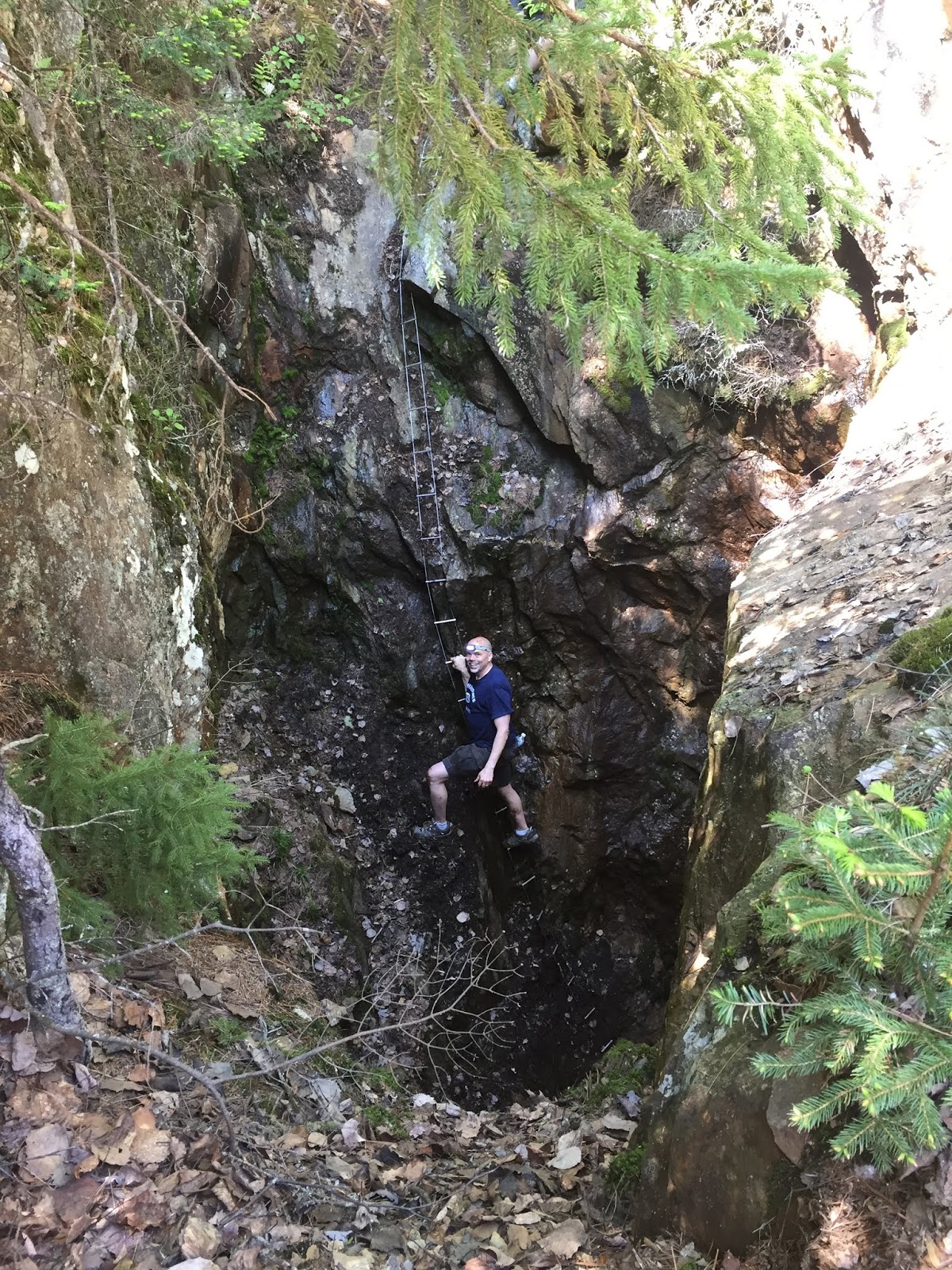
This is a story that is two years in the making. The Paddock Pit is a mineshaft on Gardner Mountain in northwest New Hampshire that drops 80-feet straight into the earth, then continues into a large chamber and pair of horizontal shafts, jutting out at two different levels. This is one of several copper mines located on the mountain, all of which were worked at various points in the late 1800s.

I spent 30 hours driving back and forth from this mountain over a series of explorations in the summer of 2017, and although each of the mines were impressive, this particular shaft is one of the largest, and most dangerous, we have explored in New Hampshire. This opening is its only entrance, and having arrived completely unprepared for its size, my first attempt at exploring it I could only stand safely from a distance and imagine what treasures lie hidden within. The day wasn't a wasted trip as we still had another mine to explore, but I realized it was going to take a lot more than some spool of rope to get me down into this hole.


Our first descent into the mine was made possible by Amazon, who really does have everything for sale on its website. We purchased two 30-foot steel caving ladders, linked them together, and after securing them to a large tree took turns descending into the unknown. This ladder might look a little sketchy from a distance, but it has a load rating large enough to hoist a grand piano.


However, we soon realized that this day was going to be good, but it wasn't going to be great. Our ladder got us down to the first level, but it wasn't long enough to reach the bottom. We were stuck at the 60-foot mark, where a precarious ledge provided just enough stability to stand on and have a look back up. An additional 20-feet were going to be needed to reach the bottom of the pit, though.


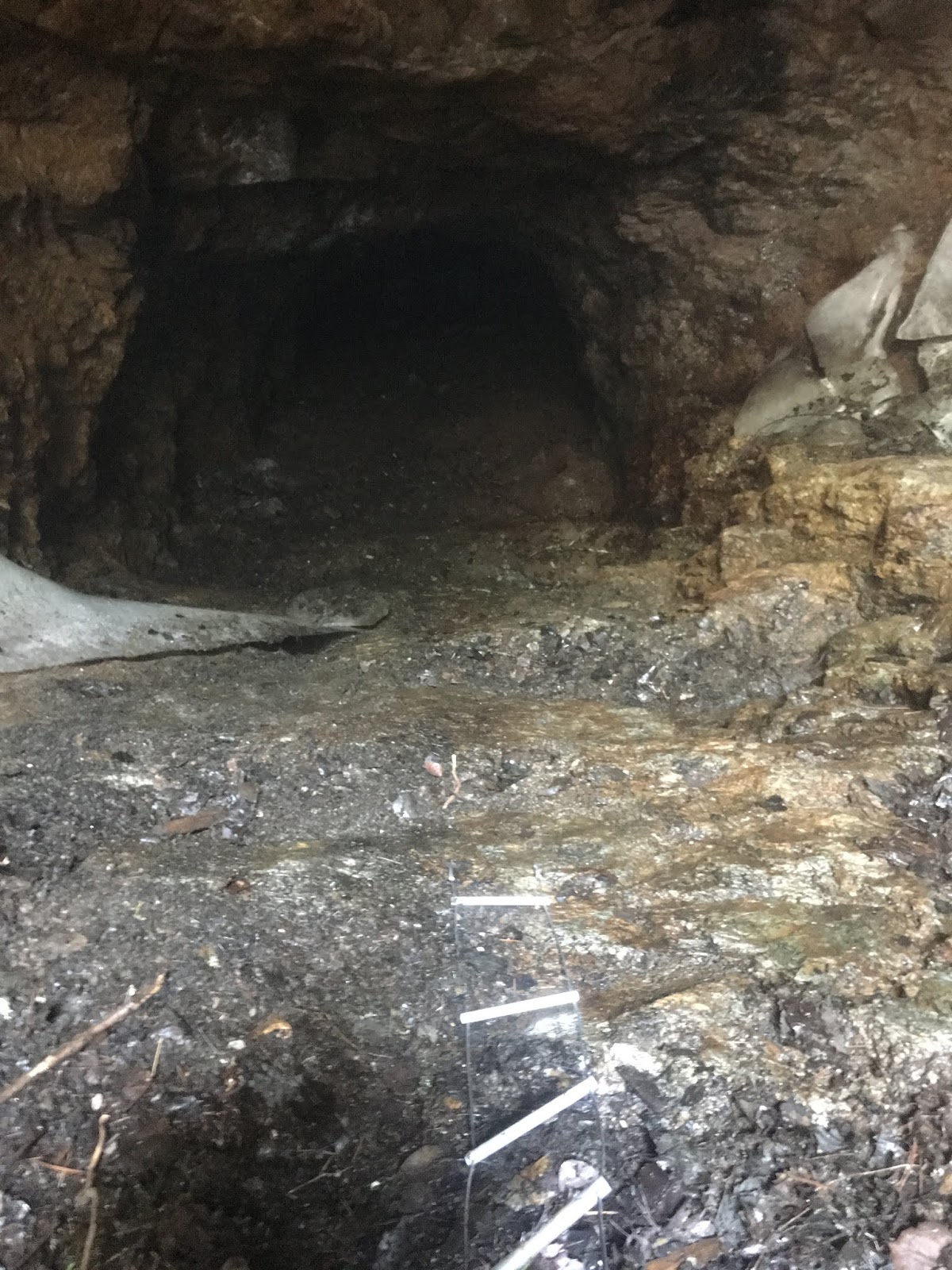
But even though we couldn't continue vertically, it didn't stop us from exploring what we could horizontally. By holding the ladder and shimmying to the left we were able to access a tunnel jutting out from this ledge, which wound its way through approximately 80 feet of rock.


That side tunnel was a nice bonus, but with our ladder stopping short of the bottom this day's expedition was taking us no further. The remainder of the shaft was a wet slope, and the more sensible people in our group reminded me that even though I could slide down that slope easily enough, I wasn't going to be able to climb back out.


It wouldn't be until we returned a few weeks later with additional rope that we would finally reach the bottom of the mine. Leaving one person up top as a security measure - a position my wife cheerfully volunteered for - our group took turns climbing all the way down into the lowest chamber. This was the view looking back up from the those depths, where sunlight can be seen penetrating the shaft.


This bottom level consisted of one large cavern and three separate tunnels. One of the tunnels was very short, and a second one was very short plus flooded. The cavern itself held lots of rubble, but scant remnants of past explorers - this is an area that has seen very few visitors over its 100+ years of existence.


The third tunnel shooting off from this chamber was the real prize, dry and about 80 feet in length - much like its partner sitting one story above. But though the tunnels look nearly identical, the difference in quality between the photo I took one level up, and this one taken by our friends from WeRmudfun, is what convinced me that if I want to be taken more serious an an explorer, maybe I should be snapping pictures with something a little better quality than a two year old iPhone.
Photo courtesy of WeRmudfun


Here I am at the end of the longest tunnel, off of the lowest chamber. This spot marks the deepest depth, or at least the furthest distance from the surface, of the mine, and after one false start and another partial success, it also marks our completed exploration of the Paddock Pit.
Photo courtesy of WeRmudfun

Saturday, May 18, 2019

Abandoned Oak Ridge Observatory - Harvard, MA


My whole life I have been fascinated with outer space. When you picture somebody looking up at the stars and wondering if anyone is out there looking back at them, I'm that guy. Many years of driving to night college were made tolerable by the Coast to Coast AM radio show which, if you don't mind sitting through a fair amount of weirdness, discusses all things related to the universe.

I'm also a fan of anything abandoned, having spent the past several years exploring dozens of places that are forgotten and neglected. It's a rare occasion these two worlds would ever have an opportunity to meet, but that's just what happened when I explored an abandoned observational campus in the woods of Harvard Massachusetts.


Opened in 1933, Oak Ridge once operated the largest optical telescope east of Texas, and is credited with the discovery of 38 minor (dwarf) planets and asteroids within our solar system. Oak Ridge also boasted of an 84-foot radio telescope which was used in Project BETA, their search for extraterrestrial intelligence. More on that one in a bit.

The dome below housed a telescope called the 16" Boller and Chivens Cassegrain reflector. While it is no longer inside, if you visit the the National Air and Space Museum's Public Observatory in Washington, DC, you may get a chance to use that very piece of equipment. What used to operate within this building has been relocated there for public use.


I took the above picture while standing on this cement platform, which once held a pair of open-air scopes called the Damon Patrol Cameras.


The largest building at this complex is this funny cylindrical structure which is home to the massive 61" Wyeth telescope, first installed in 1934 and then upgraded with a Pyrex mirror in 1936. Pyrex is less prone to warping with changes in air temperature than glass, beneficial when the roof was rolled back and the telescope exposed to cold night air. This telescope was operated in partnership with the Smithsonian Astrophysical Observatory until the complex shut down in 2005.


What I assumed was a small storage shed I later learned was the observatory's darkroom, housed in its own building.


It wasn't just the skies researchers studied at this facility - sometimes they looked down. Below is the seismograph building where the US Geological Survey measured tremors, then by triangulating these tremors with other facilities were able to pinpoint the source of the disturbance.


Walk a little ways into the woods and you'll find a beautiful stone building, where researchers once lived.


Though impressive in its day, as anyone who's ever owned the same cell phone for more than a few years knows, technology moves at a rapid pace. What was once state of the art is now abandoned scraps on a hilltop in Massachusetts. That doesn't mean the university has given up its research, however, they just now operate out of a newer facility at the Harvard-Smithsonian Center for Astrophysics in nearby Cambridge.


The only piece of equipment I wasn't able to see was the 84 foot radio telescope, which once stood on this platform. After suffering severe damage during a storm over ten years ago it was dismantled and removed. But here comes the fun part of the story, because that dish once played a part in the BETA program operated by SETI. SETI stands for the Search for Extraterrestrial Intelligence, and BETA was a program run by SETI called the Billion channel Extra-Terrestrial Assay. Essentially, this was once a small piece of a much larger program that to this day continues searching for life in our universe.

Before you go running for the home button on your browser, hear me out. When considering whether life exists outside of Earth there are two distinct groups. One you know of already, the group that classifies any bright light in the sky as a UFO - great for an afternoon of entertainment on YouTube. Then there is the SETI community - legitimate scientists under the assumption that with trillions of stars in our universe, life almost certainly has arisen elsewhere. But they go looking for it in a very different way.

Imagine trying to figure out whether life exists here on Earth, from light years away. One method would be the massive engineering feat of sending spaceships to our planet to have a look; doable but improbable. A much easier method would be to simply sit back and listen. With a strong enough receiver, even from many light years away you'd be able to pick up all sorts of signals "leaking" from our planet, including early television programs and military communications. A big joke among the scientific community is that searchers on a planet 60 light years from us might actually be receiving episodes of I Love Lucy at this very moment. SETI searches the skies for these signals leaking away from other star systems, and although nothing has been found definitively yet, a few signals have given searchers hope. One of those was a reception called the "Wow!" signal, picked up back in the 70's.

Just how much of a nerd am I when it comes to this stuff? I'm writing this while drinking coffee from my SETI mug, something I purchased off the seti.org website over 10 years ago. I've been following them for a long time now, and one of my greatest hopes is that they find a conclusive signal at some point within my lifetime.

Saturday, May 4, 2019

Frog Rock, New Boston NH


Although it's happened before, it is a rare occasion when we can entice our youngest daughter to spend an afternoon hiking with us. When you're responsible for answering hundreds of Snapchats on any given day, there just aren't enough hours left over for nuisances such as exercise and fresh air. We'd have to be going somewhere pretty exciting for her to join in, and to invite her on an adventure where our goal is to see a rock? That's the king of suggestion that'll have her pulling out the birth certificate and questioning her family lineage.

This is Frog Rock, and it doesn't take much imagination to understand where it got its name.


But what does take imagination is understanding how a hundred years ago this was a popular destination. Woods now surround the entire area, and the grassy plain visitors once picnicked on is a thing of the past. So, in large part, is the memory of Frog Rock. Although trails will lead you within a couple dozen feet of it, there isn't a single sign or marker indicating the rocks existence. Without knowing what you're looking for, you'd likely walk right past it.

To see the rock requires just a 10 minute hike, beginning at a trailhead along the 2nd NH Turnpike in New Boston. Frog Rock is not the only interesting thing you will see along the way, either. This former road was home to houses and at least one barn, the foundations of which still remain.


Some of the walls were so tall, my wife was able to wander amongst them like a corn maze.


I have come across several Lincoln Log cabins in the woods of New Hampshire, and the majority were abandoned after just a couple of layers. Such is the case below. My conclusion is that most people go into this thinking they can build one with not much more effort than it took as a kid.


Eventually, if you make a right hand turn where you see just the hint of a trail, you will arrive at Frog Rock. Much like our former Old Man of the Mountain, from most directions this will look like just a big old pile of nothing. But get it from the right angle and it suddenly takes the form you are looking for.

Although it only takes a moment to admire and photograph it, we'd already devoted an afternoon to finding it and weren't going to leave without a little fun. One of our group even wondered if giving it a kiss might magically produce for her a dashing young prince. I can't speak for the results any of you might have, but I can confirm that this young lady was quite smitten with who accompanied her out of the woods that afternoon.


To see Frog Rock for yourself, follow the directions given on the New Boston Historical Society's website below. And be sure to look for WeRmudfun's video clip at the bottom of the page for a special guest appearance.

http://www.newbostonhistoricalsociety.com/frogrock.html

Friday, April 19, 2019

Ruins of the Greystone Lodge


Built in 1911, the Greystone Lodge of Antrim NH was once a grand resort catering to wealthy people, many who would travel up from Boston. It boasted of such amenities as a rustic interior, large fireplaces, and upscale activities like tennis and a private golf course. In part due to the great depression, however, the lodge thrived for just two decades before closing its doors sometime in the 1930s.


Passing through a variety of owners, the lodge periodically hosted private events up into the 1960s, but at the same time it had become a party destination for local youth. Residents describe how it was not uncommon to hear raucous activity echoing down the mountain after dark, and after one such night in November of 1970, the building burned to its shell.


Greystone's rustic interior was not only a bonus for those visiting during its lifetime, it's a bonus for explorers like us who visit it in death. Atop Nahor Hill still stands much of the original stone frame, steadily being consumed by vegetation.


There's a creepiness that comes with wandering through woods among decades old ruins, particularly in a town you've never been to. Adding to that vibe were these old shoes we unearthed, and my wife and I have seen too many B-horror movies not to recognize that a collection like this would account for every member of some poor, unsuspecting family.


But in addition to creepiness there were yucks to be had, because you're not going to pass an abandoned oven without my wife pretending to pull a hot apple pie out of it.

Scrambling through this debris while on the lookout for rusted nails and poison ivy, it was hard to visualize what a grand place this once must have been. But I found an old postcard on Amazon, and for $5 it shows us the Greystone Lodge in all its glory.


And if Mae is to be believed, the Greystone Lodge was as enjoyable a destination as it claimed. Also, in case any of my children ever read this post, the style of writing you're looking at is called cursive.


One of our favorite places to explore are ruins, as they combine several things we enjoy most in life into one activity. Hiking, exploring, learning about local history - you can check all those boxes off with a single trip to the Greystone Lodge ruins.


Further Reading:
http://archive.antrimlimrik.org/1995/1995-09%20LIMRIK%20Sept%201995.pdf